Why Enterprises Should Avoid Template Websites: Core Differences Between Custom and Template Development
Enterprise Web Architecture & SEO Lab
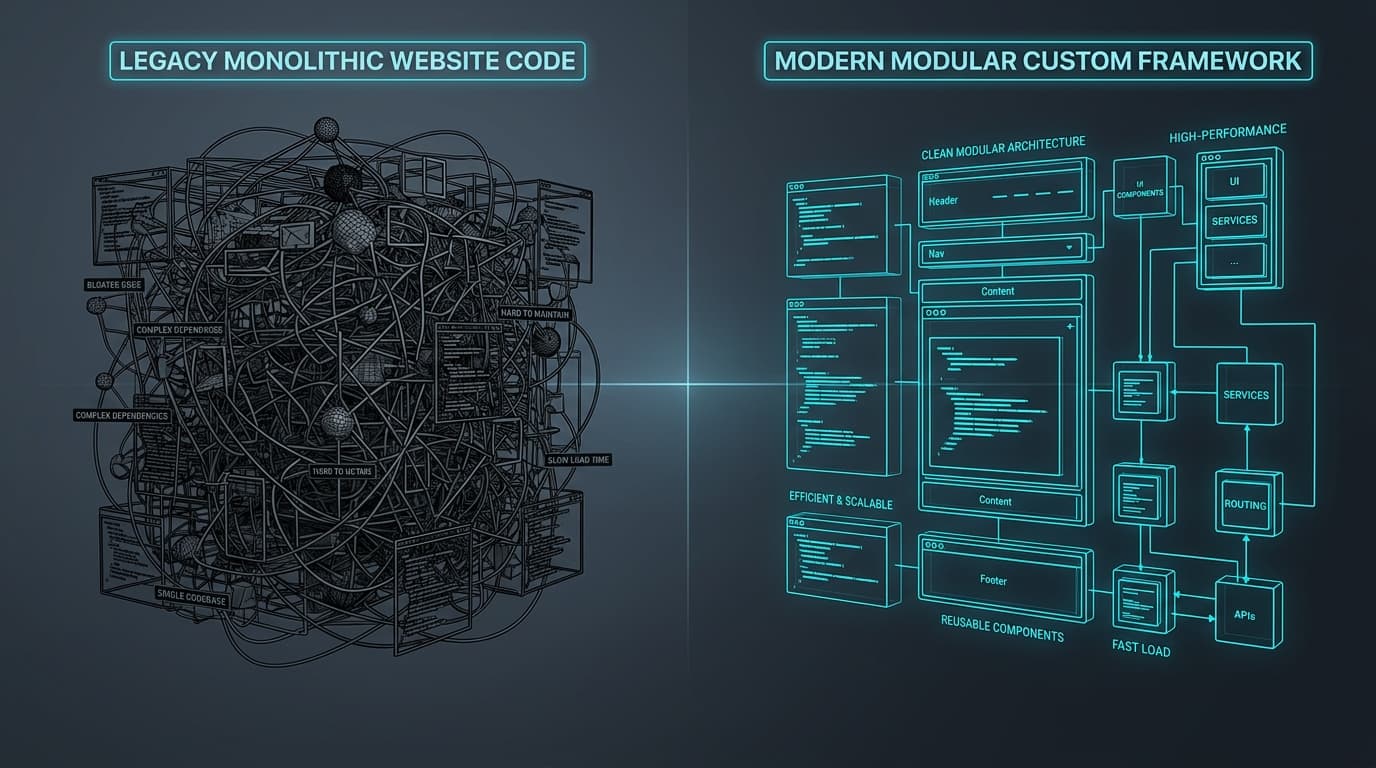
Template websites appear economical upfront but introduce code bloat, rigid constraints, missing technical SEO infrastructure, and heavy technical debt. This guide deconstructs architecture, brand authority, and commercial conversion.
01.The Surface Appeal of Templates vs. Compounding Technical Debt
During digital transformation and global market expansion, decision-makers are frequently attracted by pre-built templates and SaaS drag-and-drop site builders boasting minimal upfront pricing and 'launch in 3 days' promises. However, behind this superficial shortcut lies compounding technical debt and high long-term switching costs.
The foundational architecture of template builders is 'bundling massive generic code to satisfy thousands of hypothetical use cases'. To enable drag-and-drop flexibility, template platforms force every page to load full component libraries, unminified legacy JavaScript, sprawling global CSS stylesheets, and deeply nested DOM trees. Even when a business only needs to present several core products and value propositions, browsers and search crawlers are forced to download and evaluate megabytes of redundant assets.
This code bloat not only prolongs First Contentful Paint and white-screen delays, but also creates insurmountable roadblocks whenever the business needs custom interaction logic, regional tracking, or direct CRM integrations. When business needs inevitably outgrow template limits, teams are forced to rebuild from scratch, turning earlier investments into total sunk costs.
02.How Template Limitations Undermine Rankings, Brand Trust, and Compliance
Many organizations mistakenly assume that an 'acceptable visual appearance' is sufficient for a website, overlooking the technical indexing mechanisms of search engines and the rigorous evaluation process of high-value B2B buyers:
Key impact summary:
- Severe Experience & Visual Homogeneity: Thousands of small sites share identical stock layouts and animations, lacking unique brand narratives and industrial-grade polish, failing to build trust with global enterprise procurement teams.
- Missing Technical SEO Foundations: Generic templates cannot customize page-level Schema.org structured data (JSON-LD), canonical URL logic, dynamic sitemap.xml files, or robust x-default multi-language fallback tags, crippling organic search visibility on Google.
- Code Bloat Leading to Failed Core Web Vitals: Largest Contentful Paint (LCP) and Cumulative Layout Shift (CLS) consistently fail Google's benchmarks due to blocking third-party plugins, triggering search ranking penalties.
- Restricted Data Sovereignty and Server Lock-in: Proprietary SaaS platforms keep code and server environments closed. If terms, pricing, or uptime policies change, migrating digital assets to independent cloud infrastructure is extremely painful.
For enterprises aiming for international competitiveness and B2B client acquisition, a website is a vital commercial asset and inquiry hub. Foundational code flaws directly degrade the ROI of paid marketing and organic search acquisition.
03.Investing in Long-Term Digital Assets: The Value of Custom Engineering
Custom development with Next.js is not about reinventing the wheel—it is about engineering a clean, high-speed, fully controllable digital foundation tailored to your commercial positioning, target audience network conditions, and operational roadmap. Custom engineering ensures every line of code and API request directly serves your conversion funnel.
A custom-engineered website delivers sub-second page delivery, rigorous technical SEO architecture, and seamless integrations with modern Headless CMS platforms, localization workflows, and internal business systems. Marketing teams manage content intuitively while the frontend codebase maintains maximum stability, security, and agile scalability.
In summary, template builders serve ultra-budget, temporary placeholder needs. Once an enterprise enters growth, brand upgrading, or deep global expansion phases, investing in a high-performance custom website builds an enduring moat for brand equity and sustained lead generation over the next 3 to 5 years.
Related Technical Insights
B2B Website Content Architecture: How Brand Operators Build High-Converting Product & Solution Portals
Engineering Trust in B2B Deals: How Brand Marketers Build High-Impact Customer Case Studies
Maximizing Inbound Conversion: How B2B Marketers Optimize Lead Capture Funnels on Corporate Websites
How to Choose a Domain for Multilingual Websites: Subdirectory, Subdomain vs. New Domain
Corporate Website Pricing: Why Quotes Range from $500 to $10,000 and How to Budget
Why Your B2B Website Gets No Inquiries: Core Google Indexing and Ranking Mechanisms
Template Website UX Issues: Core Web Vitals Bottlenecks, Mobile Adaptation, and Brand Trust Crises
2026 Corporate Website Architecture Guide: Next.js + Headless CMS in Practice
Need a structured plan for your corporate website?
Share your business goals, target markets, and current materials. We will first clarify scope, implementation path, and delivery boundaries.
Book a consultation