Why Your B2B Website Gets No Inquiries: Core Google Indexing and Ranking Mechanisms
Enterprise Web Architecture & SEO Lab
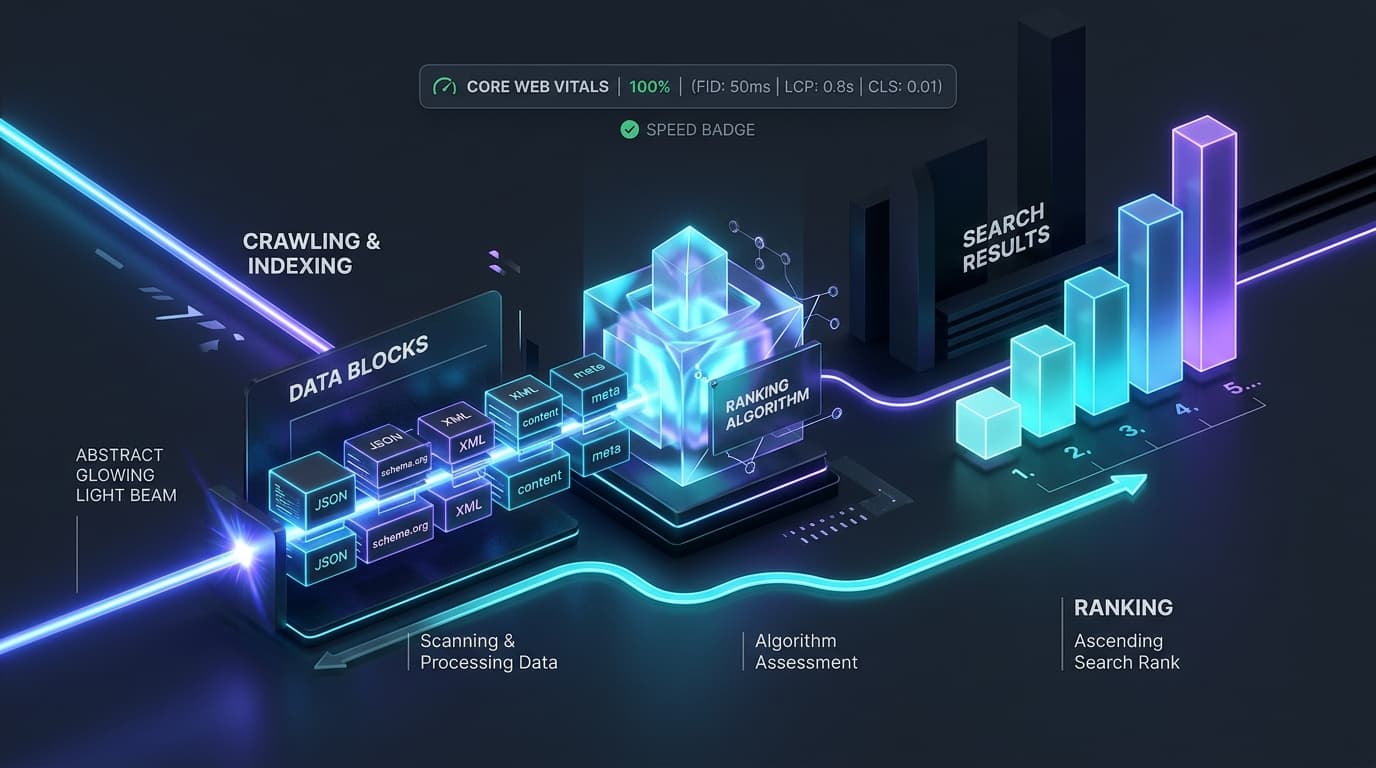
Many B2B and export websites sit on Google for months with zero ranking or inbound inquiries. This non-technical guide explains Google crawling, raw HTML indexing, Core Web Vitals performance benchmarks, and search intent alignment.
01.Google's Core Pipeline: Crawling, Indexing, and Ranking Explained
Many businesses assume that submitting a domain to Google automatically guarantees a steady stream of overseas buyers. Yet months later, searching for their core product keywords returns zero visibility. The root cause lies in failing Googlebot's foundational technical gatechecks.
Google evaluates every website through three sequential phases: Crawling (discovering URLs via links), Indexing (parsing raw HTML, semantics, and structured data), and Ranking (scoring relevance against search intent and page experience signals).
If a website stumbles at the Indexing phase due to client-side rendering empty shells, bloated scripts, or missing metadata, it is disqualified from search candidate pools before ranking algorithms even engage.
02.Four Critical Technical SEO Pitfalls Blocking B2B Websites
Websites suffering from zero search inquiries almost invariably suffer from these hidden engineering flaws:
Key impact summary:
- Fake Widget Translations: Relying on browser-only translation bars leaves raw HTML empty or untranslated. Googlebot crawls pure Chinese or blank markup, preventing international indexing.
- Failing Core Web Vitals Benchmarks: Slow LCP (>3.5s) or shifting CLS (>0.25) signals poor page experience, directly lowering algorithmic search distribution.
- Missing Schema.org Microdata: Lacking JSON-LD markup (Organization, Product, FAQPage) forfeits rich snippet real estate in Google SERPs.
- Disorganized or Absent Hreflang Tags: Failing to map language alternates causes search engines to flag localized pages as duplicate content.
These architectural defects silently drain marketing efficacy, hiding your product catalog from international procurement officers.
03.Building an Engineered, High-Ranking B2B Website That Generates Leads
To secure sustained organic search traffic, technical SEO must be prioritized during initial build. Frameworks like Next.js generate fully semantic, pre-rendered static HTML that search crawlers parse in milliseconds.
Combine server pre-rendering with automated sitemap.xml generation, canonical URLs, precise hreflang tags, and global edge CDN caching to deliver an instant experience across North America, Europe, and Asia.
Technical SEO is the foundational moat of global digital marketing. An engineered website compliant with modern Google standards functions as a 24/7 global sales representative, generating high-value business inquiries continuously.
Related Technical Insights
B2B Website Content Architecture: How Brand Operators Build High-Converting Product & Solution Portals
Engineering Trust in B2B Deals: How Brand Marketers Build High-Impact Customer Case Studies
Maximizing Inbound Conversion: How B2B Marketers Optimize Lead Capture Funnels on Corporate Websites
How to Choose a Domain for Multilingual Websites: Subdirectory, Subdomain vs. New Domain
Corporate Website Pricing: Why Quotes Range from $500 to $10,000 and How to Budget
Why Enterprises Should Avoid Template Websites: Core Differences Between Custom and Template Development
Template Website UX Issues: Core Web Vitals Bottlenecks, Mobile Adaptation, and Brand Trust Crises
2026 Corporate Website Architecture Guide: Next.js + Headless CMS in Practice
Need a structured plan for your corporate website?
Share your business goals, target markets, and current materials. We will first clarify scope, implementation path, and delivery boundaries.
Book a consultation